
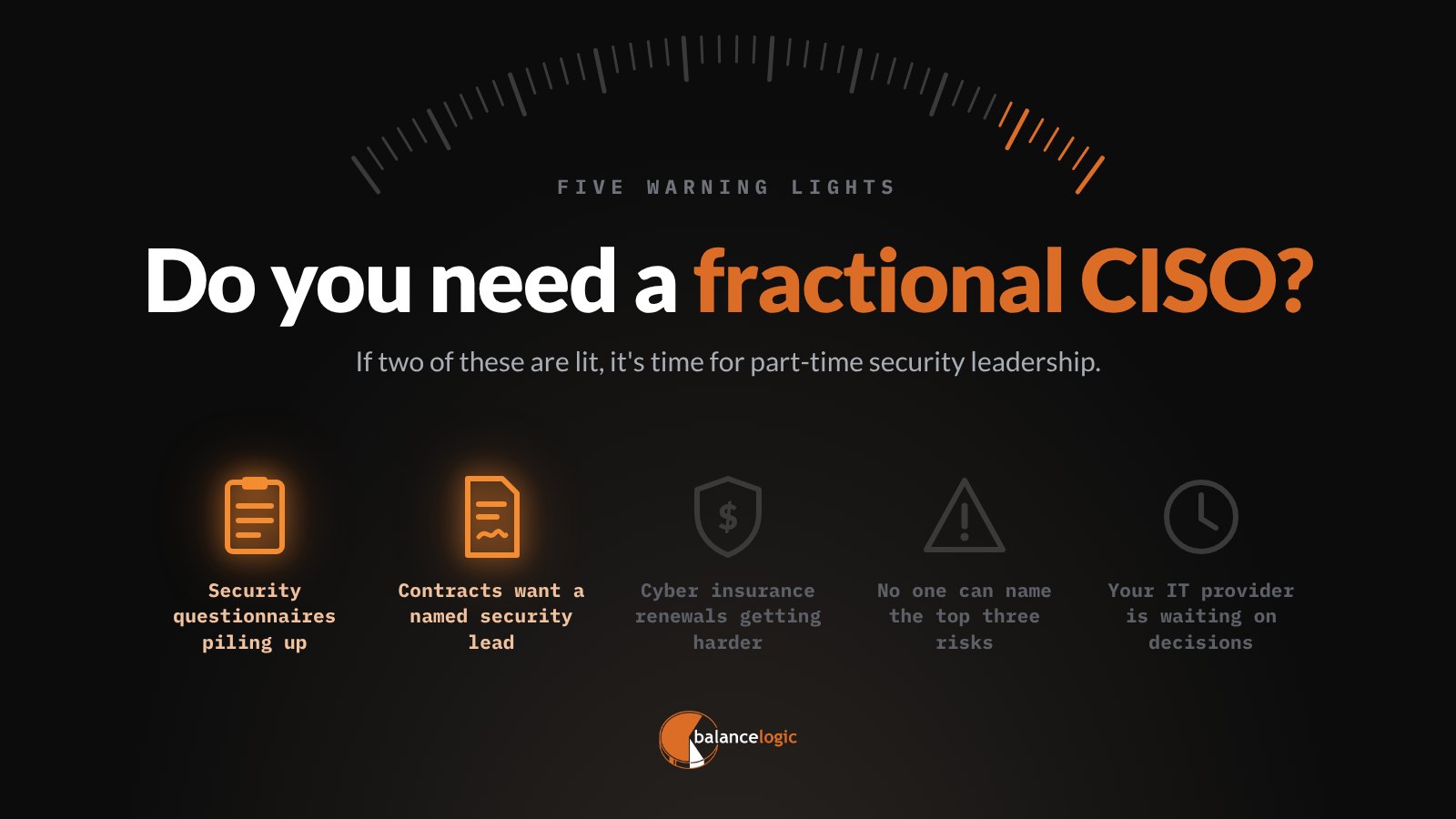
It’s time for a fractional CISO when security decisions keep landing on people who don’t own them: customers send security questionnaires nobody can answer, a contract or regulation expects a named security lead, insurance renewals get harder, nobody can name your top risks, or your IT provider is waiting on decisions only leadership can make. A fractional CISO gives you part-time security leadership, a named person accountable for the security plan, without hiring a full-time executive.
Here are the five signs in more detail, plus a quick self-score you can run in five minutes.
What a fractional CISO actually does
A chief information security officer (CISO) owns security strategy and risk decisions. A fractional CISO does the same job part time. That usually means setting the security roadmap, writing and owning policies, deciding which risks to fix first, answering to customers and auditors, and reporting to leadership in plain English.
What a fractional CISO doesn’t do is the day-to-day hands-on work. Patching, monitoring and device management stay with your internal IT team or your MSP. The CISO sets the plan and the priorities. Your IT provider carries them out.
Sign 1: Security questionnaires are piling up
A customer sends a 200-question security questionnaire before renewing a contract. Someone in sales forwards it to IT. IT answers the technical questions, but nobody can answer the ones about policy, risk assessment or incident response, because nobody owns those things.
If questionnaires sit unanswered, or get answered with guesses, that’s a leadership gap, not a technical one. A fractional CISO owns the answers and the documents behind them.
Sign 2: A contract or regulation expects a named security lead
Several rules either name a security role outright or put security obligations on the business that someone has to own. A few examples from the primary sources:
- The FTC Safeguards Rule requires covered financial institutions to designate a “Qualified Individual” to oversee the information security program. The rule allows that person to work for a service provider, but the business keeps responsibility and must designate a senior person to oversee them.
- The HIPAA Security Rule requires covered entities and business associates to identify a security official responsible for security policies and procedures.
- Defense contractors whose contracts include DFARS 252.204-7012 must provide adequate security for covered defense information, which points to the NIST SP 800-171 security requirements.
If one of these applies to you and you can’t name the person, that’s sign number two.
Sign 3: Cyber insurance renewals are getting harder
Insurance applications often ask detailed questions about multifactor authentication, backups, incident response plans and employee training. If filling out the renewal form feels like an exam you didn’t study for, you need someone who owns those controls year round, not just in the week before the deadline.
Sign 4: Nobody can name your top three security risks
Ask your leadership team: what are our three biggest security risks, and what are we doing about each one? If you get silence or three different answers, security is happening by default.
The NIST Cybersecurity Framework 2.0 includes a Govern function. It describes cybersecurity risk strategy, expectations and policy as things an organization establishes, communicates and monitors, along with clear roles and responsibilities. That’s leadership work.
Sign 5: Your IT provider is waiting on decisions
A good MSP will tell you what it recommends. It shouldn’t decide on its own whether the business accepts a risk, grants an exception to multifactor authentication for the owner’s phone, or spends money on a new security tool. Those are business decisions.
When recommendations sit in your inbox for weeks because nobody has the authority or context to say yes or no, a fractional CISO closes that gap and gives your provider clear direction.
Quick self-score: do you need a fractional CISO?
Give yourself one point for each statement that’s true today:
- We’ve received a security questionnaire in the last year that we struggled to answer.
- A contract, regulation or insurer expects a named person responsible for security, and we can’t name one.
- Our last insurance renewal raised questions we couldn’t answer confidently.
- Our leadership team can’t agree on our top three security risks.
- Our IT provider has open recommendations waiting on a leadership decision.
0 to 1: keep an eye on it and revisit at your next planning cycle. 2 to 3: security leadership is a real gap; scope a fractional CISO engagement. 4 to 5: it’s urgent, because decisions are already being made by default.
Fractional CISO or full-time hire?
A full-time CISO makes sense when security leadership needs a person every day. Most small and mid-sized businesses need security decisions made well, consistently and on time, but not 40 hours a week. A fractional CISO lets you match the level of involvement to what the business needs now and adjust as you grow. Our guide on building a security program without a full-time CISO goes deeper on that choice.
How we approach it
Balancelogic® Fractional CISO Services cover cybersecurity roadmaps, assessments, program development and GRC software administration, with security and risk decisions owned at the leadership level. Defense contractors can start with the Balancelogic CMMC Readiness Review. Your internal IT team or MSP keeps doing the hands-on work.
Balancelogic partners with our sister company ITAssurance℠ when ongoing managed IT, cybersecurity, and operational support are needed.
If two or more signs sounded familiar, book a free IT Strategy Session and we’ll talk through where to start.
Frequently asked questions
What does a fractional CISO do?
A fractional CISO provides part-time security leadership: setting the security roadmap, owning policies, deciding which risks to address first, answering customer and auditor questions and reporting to leadership. Hands-on work like patching and monitoring stays with your IT team or MSP.
Is a fractional CISO the same as an MSP?
No. An MSP manages and protects your technology day to day. A fractional CISO owns security strategy and risk decisions. The two roles work together.
Can a fractional CISO serve as the Qualified Individual under the FTC Safeguards Rule?
The rule allows the Qualified Individual to be employed by a service provider, but the business keeps responsibility for meeting the rule and must designate a senior member of its own staff to oversee that person. Confirm your obligations with your legal advisor.
How do I know if I need a fractional CISO or a full-time CISO?
If you need consistent security leadership but not a full-time executive every day, a fractional CISO is usually the better fit. A full-time hire makes sense when security decisions and oversight need someone in the role daily.
Our work supports your compliance program. It doesn’t guarantee compliance, certification or audit results.