
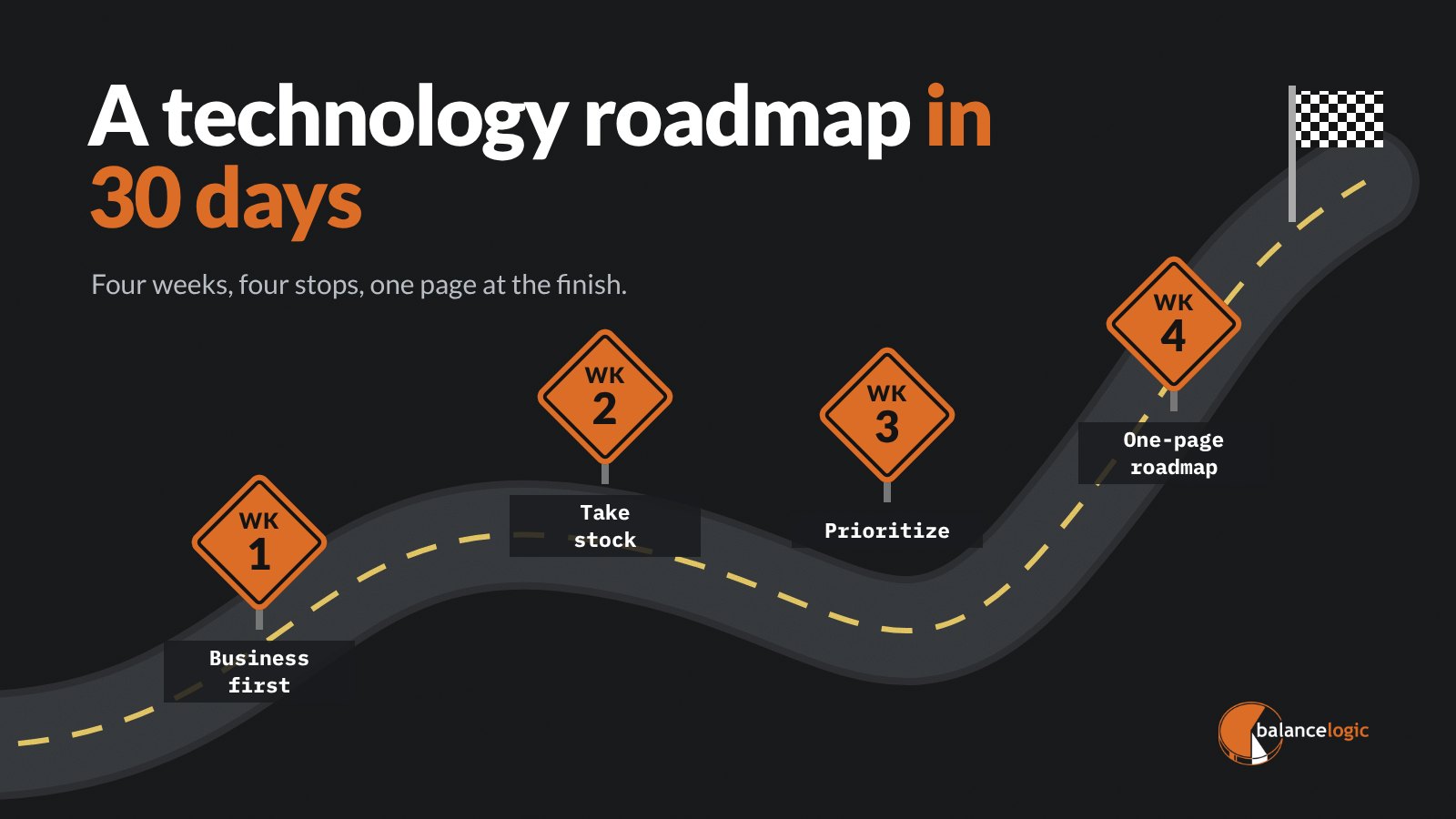
You can build a working technology roadmap in 30 days by giving each week one job: week one, learn the business goals; week two, take stock of what you have; week three, choose and sequence priorities; week four, turn them into a one-page plan with owners and rough costs. Use the last two days to get leadership sign-off and put a quarterly review on the calendar.
A technology roadmap is a short, time-based plan that shows which technology changes the business will make, in what order, and why. Here’s the week-by-week plan, with the outputs you should have at the end of each week.
The 30-day plan at a glance
| Days | Focus | What you’ll have at the end |
|---|---|---|
| 1 to 7 | Business goals | Three to five goals for the next 12 to 24 months, in leadership’s words |
| 8 to 14 | Current state | An inventory of systems, vendors, renewals, hardware age and known risks |
| 15 to 21 | Priorities | A scored list of initiatives, sorted into Now, Next and Later |
| 22 to 28 | The roadmap | A one-page, quarter-by-quarter plan with owners, dependencies and cost ranges |
| 29 to 30 | Sign-off | Leadership approval and a recurring quarterly review |
Week 1 (days 1 to 7): Start with the business, not the technology
Book 30 to 45 minutes with each member of leadership and ask the same questions:
- Where does the business need to be in 12 and 24 months?
- What’s slowing your team down today?
- What would you stop doing if you could?
- What are customers or partners asking for that we can’t deliver easily?
Then talk to two or three people who do the daily work. They’ll tell you where the real friction is. By day seven, write three to five business goals in plain language, like “Open a second location without adding admin staff.” Every item on the roadmap will have to point back to one of them.
Week 2 (days 8 to 14): Take stock of what you have
Now look at the technology through the lens of those goals. Build a simple inventory:
- Systems and software: what each one does, who uses it and who owns it
- Vendors and contracts: who provides what, and when each contract renews
- Hardware: age of laptops, servers and network equipment
- Support dates: anything nearing end of support (Microsoft publishes these on its product lifecycle pages, and most major vendors do the same)
- Known risks: security gaps, single points of failure, systems only one person understands
- Spend: what technology costs today, by category
If you’d rather have an outside view of your environment, an IT infrastructure assessment covers much of this week’s work.
Week 3 (days 15 to 21): Choose and sequence priorities
List every initiative that came out of weeks one and two, then score each from 1 to 3 on four questions:
- Business impact: how directly does it move one of the goals?
- Risk reduction: how much exposure does it remove?
- Effort: how much time, money and disruption will it take? (Score low effort as 3.)
- Dependencies: does something else have to happen first? (Score “nothing” as 3.)
Sort the results into three buckets. Now is the next two quarters. Next is the two quarters after that. Later is everything else. Be strict: if Now has more than four or five items, the plan won’t survive the first busy month.
Week 4 (days 22 to 28): Build the one-page roadmap
Put it on one page. Use this template:
| Initiative | Business goal | Quarter | Owner | Depends on | Cost range | Status |
|---|---|---|---|---|---|---|
A few rules make it work. Every initiative needs one owner, a person, not a department or a vendor. Cost ranges are fine; false precision isn’t. And the Depends on column keeps you honest: if the cloud move depends on replacing the file server, the file server goes first.
Days 29 and 30: Get sign-off and set the rhythm
Present the roadmap to leadership in 30 minutes or less. Walk through the goals first, then the Now items, then what you deliberately left for later. Ask for two decisions: approval of the Now items and the budget to fund them.
Then put a quarterly roadmap review on the calendar. Each quarter, mark what’s done, move Next items into Now, and check whether the business goals have changed. A roadmap that isn’t reviewed becomes a document nobody opens.
Common mistakes
- Starting with tools. The goals come first.
- Too much in Now. A short list that gets done beats a long one that doesn’t.
- No owners. “IT” isn’t an owner.
- Writing it once. The quarterly review is what makes it a roadmap.
Who should own the roadmap?
Someone at the leadership level, with enough technology knowledge to weigh tradeoffs and enough authority to hold vendors to the plan. In larger companies that’s a CIO. In small and mid-sized businesses, it’s often a fractional CIO. At Balancelogic®, the roadmap sits in the Leadership discipline of The Balancelogic MTP Framework™, and building it is a core part of our IT Strategy work. For more on what that first stretch looks like, read your first 90 days with a fractional CIO, or start with our SMB technology planning guide.
Want help running the 30 days? Book a free IT Strategy Session.
Frequently asked questions
What is a technology roadmap?
A technology roadmap is a short, time-based plan that shows which technology changes a business will make, in what order and why, with each item tied to a business goal and an owner.
Can a small business really build a technology roadmap in 30 days?
Yes, if you keep each week focused: goals in week one, inventory in week two, priorities in week three and the one-page roadmap in week four, with sign-off on days 29 and 30.
How far ahead should a small business technology roadmap go?
Plan the next two quarters in detail, the two after that more loosely, and keep a Later list for everything else. Review and roll it forward every quarter.
Who should own the technology roadmap?
A leader with enough technology knowledge to weigh tradeoffs and the authority to hold vendors to the plan. In many small and mid-sized businesses, that’s a fractional CIO.
This article is general information, not legal or professional advice for your specific situation.